Fullerton T

RELIGION LITURGY AND LIFE

Archive for the tag “faith”

13th Sunday in Ordinary Time

The readings for the 13th Sunday in Ordinary Time show us that God wants nothing but life and goodness for us. The first reading explains that God desires life not death for us, God created life and intended it to be eternal. The second reading tells us that God wants an abundance of good things for all of his children.  We should strive to excel in generosity, following Christ’s example. We are called to  Share all we have in order to create equality ensuring everyone’s needs are met.  

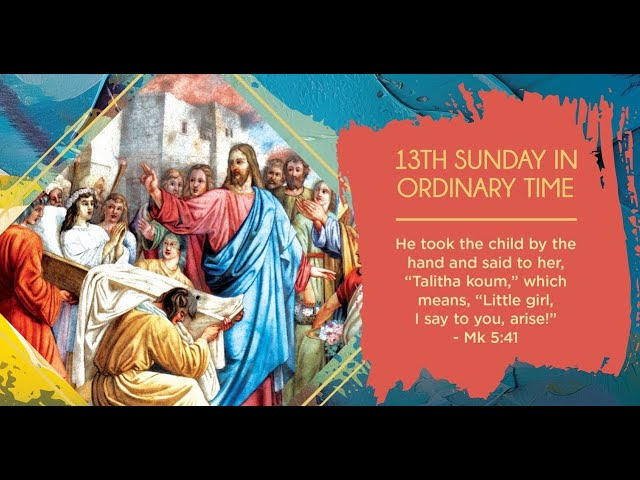
In the Gospel reading we hear about the woman who had the hemorrhage and we also hear about the official’s daughter. Whilst the stories are about the faith of the people involved they are also about the mercy of Jesus towards  them both. Jairus, the synagogue official and loving father of a ‘desperately sick’ daughter, is convinced that if  Jesus would place his hands on her ‘to make her better and save her life’ she will surely recover. The unnamed woman, suffering for twelve years from a condition for which she has gone from one doctor to another, has one last hope. She is convinced that ‘if she can touch even the hem of his clothes’, she will ‘be well again’ and then she was able to get near to Jesus and touched his garments. The poor woman and Jesus know that healing power has gone forth. Jesus turns around, inquiring who is the one who had touched him. Fearfully, the woman admits that she is the one. Jesus immediately calms her fear, telling her to go home in peace, for she is healed.

Then, He proceeds to the house of Jairus, where He learns that the little girl has died. Quieting all the commotion going on He goes in with the child’s parents as well as Peter, James, and John Taking the hand of the girl, He brings her from death to life, ordering that some food be brought to her. This gospel reading speaks of two things the faith and mercy. So, the story of the woman and Jairus daughter is also our story. When we are afraid; when we face death, we can feel Jesus’ touch, as the girl felt Jesus’ hand in hers we feel his hand in ours.  Jesus has shown that, in his hands, we are imperishable. Jesus responds to desperate need with love, empathy and compassion. He shares our pain and our burdens. He boldly shatters prejudice and breaks conventions. He is not afraid to enter the place where death seems to have its way and breaks in open with his light. Over the last few Sundays Mark has been showing us how God’s grace is at work through the person of Jesus.

Last Sunday In the calming of the storm Mark insisted that it is necessary to have faith in Jesus in order to enter into the Kingdom. As we navigate the challenges of our daily lives, we are asked to reflect on Jairus’s response. How will we choose to act? Will we, like Jairus, turn to Jesus in faith, trusting in the wisdom and faith we have received from God? Remember, faith and wisdom are not meant to be hoarded but shared. Just as wisdom aids others in finding answers for their present lives, faith offers the promise of eternal life. Therefore, we are called to embrace the wisdom and faith we have received and, in turn, generously share them with those around us as we go forward.

12th Sunday in Ordinary Time

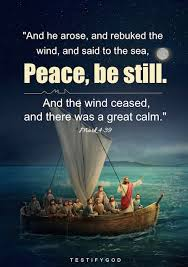
The readings for the 12th Sunday show us God’s power and our need to trust Him. In the first reading, God reminds Job of His control over the sea. He set boundaries for the waters and commands the waves. This shows God’s authority over creation. Even the mighty sea, which can be so powerful and frightening, obeys God’s commands.  Our gospel reading for this week is all about being Calm amid the storms of life that sometimes come our way. The context of this passage is the calming of the storm when Jesus rebuked the wind and said to the sea, ‘Quiet now! Be calm!’ And he says the same to us now in all our trials ‘Quiet now! Be calm!  Jesus understood that all would be well even if he and the disciples perished or if the storm subsided. Mark’s original audience was a community undergoing persecution. Their leaders had been martyred and, they questioned what was happening to them. The church was undergoing internal strife as they struggled to bring Jews and Gentiles into their new Christian community.  Mark’s church was hardly sailing on calm waters not unlike our church today.

Jesus’ previous parables of sowing, growth and harvest showed God’s control over the land. This passage also shows that God is in charge and has control over the chaos we often see and hear about exemplified for us today by the calming of the storm.  Jesus asks the disciples in the midst of the storm, why are you so frightened and why do you have so little faith. He could be saying the same thing to us today as many lack faith in God and mankind.  Amongst all the hurt and devastation in our lives Jesus changes the darkness that is in our daily lives into the sunshine of everlasting life, and replaces our distress with comfort and peace. When we don’t know the best way forward or the best way out Jesus gives us peace of mind and heart to make the right decision. At such a crossroads of life, we can ask him, ‘Lord, what road should I take what way should I Go?’ The best way will become so much clearer, and bring us calmness and peace as well as the knowledge of a decision well made.  We have so many things to occupy our minds these days with all the things that are going on in  our world.  If we stop and look around us we see the signs of Jesus in people trying their best to look after others, to provide meals and shelter, to keep themselves and their loved ones safe, to work for peace in the midst of conflict to bring comfort and to pray.  The disciples’ fear during the storm teaches us about our own fears and who we should trust. We often feel overwhelmed by life’s challenges and there are many. But Jesus shows us that He is greater than any storm. We remember that Jesus is with us in the good times and bad as a gentle calming presence as we go through the storms of life that affect all of us from time to time and we should trust him to be our helper and guide as we go forward.

11Th Sunday in Ordinary Time

This weekend we celebrate the 11th Sunday of ordinary time The readings for the 11th Sunday in Ordinary Time Year B are filled with images of growth. In the First Reading –  from Ezekiel the Lord promises to take a shoot from a cedar, plant it on a high mountain, and make it a great tree where birds will find shelter.. In the Second Reading – from 2 Corinthians 5:6-10: We are told that we walk by faith, not sight, aiming to please the Lord. We will be judged by Christ for our deeds. In the Gospel  we hear once again the story of the mustard seed. Jesus seemed especially fond of using parables. Parables are meant to leave the hearers wondering. They are not straight-forward answers to questions. They are food for thought. By using parables Jesus is trying to engage his listeners at a deeper level. He wants his teaching to seize their hearts. He wants them to discover the truth of what he is saying for themselves. It is part of the business of conversion – coming to see with new eyes

The faith that we have handed down to us through the generations is represented in this Sundays Gospel by the mustard seed and our faith is something that all of us need to nourish When the seed that is the Word of God takes root within us the Kingdom grows.  We are called upon hearing the Word to meditate upon it in prayer so that it may take root in us and bear fruit in joy and hope.  We are usually helped by books, and Christians do not want for them: the Sacred Scriptures, particularly the Gospels, liturgical texts of the day or season, writings of the spiritual fathers, works of spirituality, the great book of creation, and that of history the page on which the ‘today’ of God is written. (CCC 2705) The Kingdom of God is like a tiny seed within each of us. It’s a strong seed, like those that push their way through the hard ground  in order to grow toward the light. Sometimes we nurture it and have expectations. Sometimes our expectations are fulfilled, sometimes not. Other times, we don’t know how, but we find ourselves bearing the fruits of joy, compassion, peace, generosity, faith-fullness, gentleness with thanksgiving for the wonder of it all.  

Then we know our growth is a partnership with god the father and, while we can care for the seed, we can’t make it grow or flower or reproduce on our own. The parable of the seed growing of itself which we hear this Sunday shows us that there is an almighty power working with and for us.  Our part is to do a good job preparing the soil of our hearts and minds as we  sow the seed. When we think of the small beginnings of Jesus’ ministry in Galilee to the spread of his message throughout the world, we appreciate the vast growth from the small mustard seed that has taken place over the years. We have reason to rejoice that the kingdom still attracts and welcomes so many different people as they respond to the mustard seed of faith that someone has planted for them. So let us rejoice and be glad for the lord has done great things for us in our time and place  and helped us to nurture and grow our own faith.

Pentecost Sunday

Today we celebrate the decent of the Holy Spirit upon the Apostles and the beginning of the apostolic mission to bring the Church to the world. The readings for the Pentecost clearly tell us that we need to be willing to receive the Holy Spirit and then use the gifts we receive. In the first reading we hear how the Holy Spirit came to the disciples and empowered them to share the gospel with people from different nations as a result of this we are able to hear the word of God spoken in our own language. The second reading tells us that it is the Holy Spirit who enables us to proclaim the gospel in unity. By the time John wrote his gospel, Jewish Christians had been excommunicated for their belief in the Messiah. Ostracized and socially persecuted, some Christians reacted in fear, while others boldly proclaimed the gospel. Early Christians needed a sense of stability, a sense of divine peace.

Through the words of Jesus, “Peace” was John’s prayer for his readers as we listen to this gospel reading. With the sight of Jesus, fear turned into great joy. Anxiety turned into relief.  Desperation turned into vindication. And the lack of spiritual direction turned into a real sense of deep spiritual grounding. The divine presence stood close to them and with the divine presence came divine peace. We too have the divine presence in the Blessed Sacrament and it brings Joy and spiritual grounding to all those who come and Jesus says to each and every one of us you are welcome. We can’t ignore the problems that are there and there are many in our own lives and the lives of those around us church and otherwise.  If we pray through the problems as well as thinking them through we will find that they are much easier to get through the tough times.   Gathered at Mass week in week out we bring our prayers to God. We each have our own needs. Family and friends may be sick.  People we know need work. The person who has been central to our lives for so long has passed on.   

We bring all our concerns in prayer to church because they remind us of our need and they raise our hopes in the power of God made real to every generation through the Holy Spirit.  Through the Holy Spirit our relationship with God is fruitful, satisfies our longings, and brings us peace.  Because of God’s faithfulness to all of us, we give thanks and once again present our needs as we remember the presence of God and the Holy Spirit who are with us. The feast of Pentecost is a day of thanksgiving for the beginning of the Church, in which are contained all the treasures of spiritual grace. Pentecost is also the day of thanksgiving for the coming of the Holy Spirit firstly to  the Apostles as well as all of us. It is a day on which we renew our trust in the working  of the Holy Spirit within us and the Church in the world and  we thank Him for His inspiration and guidance in all the good and bad times and things that are part of our lives.

6th Sunday of Easter

This Sunday is the 6th Sunday of Easter. it is also the beginning of the month of May. May is the month in  which we venerate the Mother of Jesus in a special way and in our parish we are hosting the annual Novena to our Lady of Perpetual Help.

In the first reading from the Acts of the Apostles, we see a remarkable event where Peter, a Jew, realizes that God does not favour one group of people over another. As Peter spoke to a gathering that included both Jews and Gentiles, the Holy Spirit came upon everyone present. This was a clear sign that God’s love and salvation were available to all, not just a select few. Moved by this understanding, Peter baptized the Gentiles, officially welcoming them into the Christian community. This passage teaches us that God’s love knows no boundaries and that we, too, are called to transcend our prejudices and share God’s love with all.

The second reading, from the first letter of John, tells us straightforwardly: “God is love.” This profound truth is at the heart of Christian life. It means that loving others is not just a command from God, but a reflection of God Himself. When we love one another, we are participating in God’s own life.John goes on to explain that God showed this love most clearly by sending His Son, Jesus, to save us from our sins. This act of sending His only Son as a sacrifice is the ultimate example of love. Every act of love we show to others is a reflection of God’s love for us and an encounter with Him. In the Gospel for this Sunday Jesus tells us ‘As the Father has loved me, so I have loved you. Remain in my love. This is my commandment: love one another, as I have loved you.  The teaching about love is not a recent innovation, or a new-age trend as many people seem to think. Jesus does lay down a commandment for us today, but he does so, not as the master talking to servants, but as a friend speaking intimately  to other friends. Servants follow rules, their lives are dictated by the one who holds authority over them. Jesus’ religion isn’t based on such a model though many in the church today seem to think otherwise. Instead, love is the foundation of our faith. Jesus is asking us to live out of the realization of that love. We are his friends, he tells us, so now we are asked to go out and live like friends with one another. “Friends,” in this context, means “beloved ones.” We need to live out of that description for we are the beloved disciples. The instructions that Jesus gives are valuable  lessons by which we will master the love of God our Father in what we say and what we do. Jesus chose his followers to carry out God’s plan of salvation in every age he chooses us today in our turn to do the same.  

Love is the best way to become his “co-worker,” since it reveals the reason he made the world and affirms our friendship with the creator. Love changes everything it touches. It tells us to stop bragging about this or that. It enhances our reputation. It denies the power of position and wealth which we sometimes feel is ours by right, it raises us up as true leaders. It connects us to God and to one another. Divine love transcends mere emotion. It becomes our lifeline to God. And it forms the basis of real community where everyone is valued and none are left out. It is inexplicable in theory, yet easily seen in action. Wherever God loves, he acts. Wherever he acts, he is there with us. HE IS WITH US simply because he loves us and the love of God knows no bounds; we remember the love that God has for each and every one of us each time we look at the Cross. There was no greater love than the Cross of Good Friday. We are called to bring the love of God into our own lives as well as the lives of those around us remembering that the Love of God lasts forever.Jesus assures us that whatever we ask the Father in His name will be granted, emphasizing the power of living in accordance with His command to love. We experience God’s presence through the love we give and receive in our everyday interactions. Through His words and example, Jesus has equipped us to bring this divine love into the world.

As followers of Christ, we are called to live out the love of God in a real way, showing love to everyone we meet without partiality. When we show love genuinely, we make the truth that “God is love” visible and active in the world. Let us strive to embody this love in all that we do, bringing the light of Christ into every corner of our lives and our world.

2nd Sunday of Easter Divine Mercy Sunday

This weekend we celebrate the second Sunday of Easter also known as Divine Mercy Sunday when we celebrate the mercy of God in a special way. Our first reading from the acts of the apostles tells us that the early believers were united, sharing possessions and resources. The apostles’ powerful testimony about Jesus’ resurrection earned them high regard. They distributed funds meet everyone’s needs, ensuring no one was in need. These days we ask ourselves are we helping to provide for those who have needs in our own places. In the second Reading we see that  Belief in Jesus as the Christ the son of God  shows we are born of God. Loving God and His children means obeying His commandments, which are not burdensome. Our faith in Jesus as God’s Son overcomes the world, affirmed by the Spirit of truth. In the Gospel story Jesus appears to his disciples, offering peace and showing his wounds, which brought them joy. He empowered them with the Holy Spirit and the authority to forgive sins.

The Apostles were huddled together in fear. They weren’t so sure that the women’s report that Jesus had risen was believable. They weren’t singing for joy! Now, a whole week has gone by. They still felt “rocky” about their future and what it would hold for them. Thomas wasn’t the only one who had doubts about Jesus, I think so many were doubtful then as so many are doubtful right here and now. The Apostles were pondering the shocking experience of the week before when all seemed to be lost as Jesus hung on the Cross. But here we are over 2000 years later thinking about how they felt after the events of that first Holy Week.  Jesus had broken through those doors and came to assure them that he was alive and then his message must have troubled them: “As the Father has sent me, so I send you.”  The disciples  were to go out to  teach, to preach, to heal by announcing the gospel. They were going  to open the eyes of the blind, to give hearing to the deaf, and soften the hardened hearts of man. They were sent to bring the message of Jesus to others and in the same way we are sent out to bring his message to other people wherever we are by what we say and do.

We are asked to bring the mercy and love of God to all those out there who need his healing merciful touch.  We remember the joys the hope, the grief and the anxieties of the people in our time these are the joys and hopes, the grief and anxieties of the followers of Christ. The Apostles felt rocky about their future as many of us do today but god is with us as we go out into the world as his messengers. May all of us be witnesses to the Gospel bringing the mercy of God to the people of our time and place as we go forward into a the future as Easter people with Christ as our light  to help and guide us along the road we travel.

CHRISTMAS 2023

23rd Sunday of Ordinary Time

This week the local schools went back and the parents breathed a big sigh of relief now  that the summer holidays are over for another year. Its hard to believe that we are beginning another school year but that’s the nature of life from one end of the year to the next we go round in the circle of life. In this Sundays first reading the author of the book of Wisdom reflects that it is hardly surprising that we have trouble figuring out the intentions of God when we have so much trouble figuring each other. He warns: “It is hard enough for us to work out what is on earth, laborious to know what lies within our reach.” There are times when those within our reach puzzle us. Even though God has revealed himself through his Holy Spirit, nobody can claim to fully understand the mystery that is God. In the Gospel there is plenty of figuring out to be done too. Jesus gives people notice that they have to work out for themselves if they are equal to the demands of discipleship. That means that first they have to figure out the cost of discipleship, then consider whether they have the resources to meet that cost.  

To drive the point home, Jesus uses twin parables Anyone intending to build a tower would “first sit down and work out the cost”. If he started without finishing, the sum of his achievement would be a monument to his own stupidity. Likewise, the king who discovers that his forces are outnumbered would “first sit down and consider”whether the opposing arithmetic is too heavy. If he wants to be a smart survivor he will practise his speeches on the wonders of peace! In both instances the advice is clear: take the time; sit down; look at the demands; figure out whether you can honestly meet them.  Much of our lives involve figuring out what is within our reach and what we ourselves can realistically achieve. So the moral for all of us in these days of uncertainty is that when we come to make life changing decisions we need to stop and do what this gospel tells us and that is to take the time; To look at the demands the decision to be made will make on us as individuals and communities; and figure out what is within our reach and what we can realistically achieve that will help us to go forward in faith and in hope rather than backwards in fear and despair.  As we look at the way we are with all that is going on in our world let us redouble our efforts to support one another so that we are able to see what needs to be done and get on and do it.

=

14th Sunday of Ordinary Time

gather this  weekend  the schools have closed for the summer break and the holidays have begun. We remember those who are going through tough times as the cost of living continues to rise and we pray for the peace of the world especially for peace in Ukraine. This Sunday’s Gospel reading tells us about Jesus appointing the 72 others and then sending them out in pairs to the towns he was going to visit. As he gives his missionary instruction Jesus seems under no illusion about the territory compared to the wolves roaming around, his own crowds are like lambs. He tells the 72 to lead the radical lifestyle of the wandering preacher who must face homelessness and renunciation of family and property. When they enter a house they should bless it with peace. The Gospel also tells us about the practical things to direct the people  as they proclaim the Good News of the Kingdom and in rebuilding community life. Jesus told them to carry no purse, no haversack, and no sandals. Proclaiming the Good News of the Kingdom and community life are two sides of the same coin. One does not exist and cannot make sense without the other.

 There is a clear urgency about the task in hand Jesus says, “Start off now” with urgency in his voice. On their return the disciples were delighted that their mission has actually worked! Their joy demonstrates that people do welcome the word of God and that the word of God is their real resource for mission. Jesus counsels them to rejoice not because their mission has worked but because their names are written in heaven. There is a line in this gospel reading that struck me when  Jesus tells us that the Harvest is rich and the labourers are few. This is so very true today when we have a shortage of men  coming forward to enter the vocation of service that is the priesthood and religious life. But that said we need to keep on Praying for vocations and encouraging people young and not so young to become priests and religious.  There will be a time of crisis and for some we are living in a time of crisis with so many things that are wrong in our world. There will be times, as we know, when the scorpions will bite us, and when the wolves will have their day.  Jesus speaks to us today in order to reassure us and he tells us to hold on to all that is good. May our hearts our minds be open to his words! May our hearts direct our minds! And may our minds direct our hands in the work of the Lord.  

It is our responsibility as people of faith to exercise our mission as the people of God the Body of Christ. The fullness of life is the message and the mission of Jesus  who empowers us in our time and place  to do his work, and to work in his name.  Jesus assures us that we have a passport, visa, and “green card” for heaven. Our names are already registered there and our mission is to proclaim the good news of salvation to others by our words and our deeds so that the world will believe.

33rd SUNDAY IN ORDINARY TIME

download (1)

We pray today for all those who perished in Paris on Friday night this atrocity serves no one. This Sunday in our Gospel story we hear about the End times and I am sure that the people who died didn’t  think that they were approaching their end times may all of them through the mercy of God rest in peace.

For the past two millennia, Christians have looked to the future and asked, “When, Lord, when is all this going to kick off?” Jesus saw the end of time event as the visit of the divine King. God would prepare the visit with cosmic signs and events as a means of announcement. The King would arrive in a way that reflected his power and reputation (on the clouds); his messengers (“angels”) would go throughout the known world to gather all the faithful. Remember that the Jewish people had been displaced throughout the known world because of economic opportunity or oppression. Jesus implied that the injustice of Jews living on foreign soil would be corrected during his lifetime  How did his disciples know Jesus spoke the truth? Jesus gave a farming analogy of the fig tree to support his belief in God’s immanent judgement.

Every spring we observe the twigs on a bare tree start to grow and go green then Leaves appear and we know that summer is on the horizon. As Spring is a prelude to Summer, and Autumn warns of Winter so we must not be complacent, imagining that life can be held in suspension because life keeps marching on.

After the cosmic fireworks, Jesus imagines a peace beyond suffering. This vision of peace is important for Mark’s persecuted community: they need more than a firework display to see them through their own historical apocalypse. If their hope is not to be exhausted by force of circumstances, they need help to imagine a far side to pain and suffering. Mark gives their hope help in sharing Jesus’ vision. For that is the purpose of all apocalyptic writing: to fund the hope of those who suffer in the present. We live in an age of uncertainty: the future never looks wholly secure. But Jesus holds out a vision that takes us beyond our worst imaginings. There is a place beyond the mountains of arms and weapons, beyond environmental damage and terrorism. This vision doesn’t free us from the duty to strive for peace and right living, but it does free us from the blasphemy of believing that a nuclear holocaust will be the last word in the human story. In the meantime, we have to depend on the promise of Jesus: “Heaven and earth will pass away, but my words will not pass away.” No one, not even the Son, knows when all this will take place. The only sure thing we can hold on to is the word of Jesus and all we are asked to do is hold fast to what we know to be good and in these times when we look at all that is happening around us this is good advice.

Post Navigation