Fullerton T

RELIGION LITURGY AND LIFE

Archive for the tag “faith”

Pentecost Sunday

Today we celebrate the decent of the Holy Spirit upon the Apostles and the beginning of the apostolic mission to bring the Church to the world. The readings for the Pentecost clearly tell us that we need to be willing to receive the Holy Spirit and then use the gifts we receive. In the first reading we hear how the Holy Spirit came to the disciples and empowered them to share the gospel with people from different nations as a result of this we are able to hear the word of God spoken in our own language. The second reading tells us that it is the Holy Spirit who enables us to proclaim the gospel in unity. By the time John wrote his gospel, Jewish Christians had been excommunicated for their belief in the Messiah. Ostracized and socially persecuted, some Christians reacted in fear, while others boldly proclaimed the gospel. Early Christians needed a sense of stability, a sense of divine peace.

Through the words of Jesus, “Peace” was John’s prayer for his readers as we listen to this gospel reading. With the sight of Jesus, fear turned into great joy. Anxiety turned into relief.  Desperation turned into vindication. And the lack of spiritual direction turned into a real sense of deep spiritual grounding. The divine presence stood close to them and with the divine presence came divine peace. We too have the divine presence in the Blessed Sacrament and it brings Joy and spiritual grounding to all those who come and Jesus says to each and every one of us you are welcome. We can’t ignore the problems that are there and there are many in our own lives and the lives of those around us church and otherwise.  If we pray through the problems as well as thinking them through we will find that they are much easier to get through the tough times.   Gathered at Mass week in week out we bring our prayers to God. We each have our own needs. Family and friends may be sick.  People we know need work. The person who has been central to our lives for so long has passed on.   

We bring all our concerns in prayer to church because they remind us of our need and they raise our hopes in the power of God made real to every generation through the Holy Spirit.  Through the Holy Spirit our relationship with God is fruitful, satisfies our longings, and brings us peace.  Because of God’s faithfulness to all of us, we give thanks and once again present our needs as we remember the presence of God and the Holy Spirit who are with us. The feast of Pentecost is a day of thanksgiving for the beginning of the Church, in which are contained all the treasures of spiritual grace. Pentecost is also the day of thanksgiving for the coming of the Holy Spirit firstly to  the Apostles as well as all of us. It is a day on which we renew our trust in the working  of the Holy Spirit within us and the Church in the world and  we thank Him for His inspiration and guidance in all the good and bad times and things that are part of our lives.
6th Sunday of Easter

This Sunday is the 6th Sunday of Easter. it is also the beginning of the month of May. May is the month in  which we venerate the Mother of Jesus in a special way and in our parish we are hosting the annual Novena to our Lady of Perpetual Help.

In the first reading from the Acts of the Apostles, we see a remarkable event where Peter, a Jew, realizes that God does not favour one group of people over another. As Peter spoke to a gathering that included both Jews and Gentiles, the Holy Spirit came upon everyone present. This was a clear sign that God’s love and salvation were available to all, not just a select few. Moved by this understanding, Peter baptized the Gentiles, officially welcoming them into the Christian community. This passage teaches us that God’s love knows no boundaries and that we, too, are called to transcend our prejudices and share God’s love with all.

The second reading, from the first letter of John, tells us straightforwardly: “God is love.” This profound truth is at the heart of Christian life. It means that loving others is not just a command from God, but a reflection of God Himself. When we love one another, we are participating in God’s own life.John goes on to explain that God showed this love most clearly by sending His Son, Jesus, to save us from our sins. This act of sending His only Son as a sacrifice is the ultimate example of love. Every act of love we show to others is a reflection of God’s love for us and an encounter with Him. In the Gospel for this Sunday Jesus tells us ‘As the Father has loved me, so I have loved you. Remain in my love. This is my commandment: love one another, as I have loved you.  The teaching about love is not a recent innovation, or a new-age trend as many people seem to think. Jesus does lay down a commandment for us today, but he does so, not as the master talking to servants, but as a friend speaking intimately  to other friends. Servants follow rules, their lives are dictated by the one who holds authority over them. Jesus’ religion isn’t based on such a model though many in the church today seem to think otherwise. Instead, love is the foundation of our faith. Jesus is asking us to live out of the realization of that love. We are his friends, he tells us, so now we are asked to go out and live like friends with one another. “Friends,” in this context, means “beloved ones.” We need to live out of that description for we are the beloved disciples. The instructions that Jesus gives are valuable  lessons by which we will master the love of God our Father in what we say and what we do. Jesus chose his followers to carry out God’s plan of salvation in every age he chooses us today in our turn to do the same.  

Love is the best way to become his “co-worker,” since it reveals the reason he made the world and affirms our friendship with the creator. Love changes everything it touches. It tells us to stop bragging about this or that. It enhances our reputation. It denies the power of position and wealth which we sometimes feel is ours by right, it raises us up as true leaders. It connects us to God and to one another. Divine love transcends mere emotion. It becomes our lifeline to God. And it forms the basis of real community where everyone is valued and none are left out. It is inexplicable in theory, yet easily seen in action. Wherever God loves, he acts. Wherever he acts, he is there with us. HE IS WITH US simply because he loves us and the love of God knows no bounds; we remember the love that God has for each and every one of us each time we look at the Cross. There was no greater love than the Cross of Good Friday. We are called to bring the love of God into our own lives as well as the lives of those around us remembering that the Love of God lasts forever.Jesus assures us that whatever we ask the Father in His name will be granted, emphasizing the power of living in accordance with His command to love. We experience God’s presence through the love we give and receive in our everyday interactions. Through His words and example, Jesus has equipped us to bring this divine love into the world.

As followers of Christ, we are called to live out the love of God in a real way, showing love to everyone we meet without partiality. When we show love genuinely, we make the truth that “God is love” visible and active in the world. Let us strive to embody this love in all that we do, bringing the light of Christ into every corner of our lives and our world.

2nd Sunday of Easter Divine Mercy Sunday

This weekend we celebrate the second Sunday of Easter also known as Divine Mercy Sunday when we celebrate the mercy of God in a special way. Our first reading from the acts of the apostles tells us that the early believers were united, sharing possessions and resources. The apostles’ powerful testimony about Jesus’ resurrection earned them high regard. They distributed funds meet everyone’s needs, ensuring no one was in need. These days we ask ourselves are we helping to provide for those who have needs in our own places. In the second Reading we see that  Belief in Jesus as the Christ the son of God  shows we are born of God. Loving God and His children means obeying His commandments, which are not burdensome. Our faith in Jesus as God’s Son overcomes the world, affirmed by the Spirit of truth. In the Gospel story Jesus appears to his disciples, offering peace and showing his wounds, which brought them joy. He empowered them with the Holy Spirit and the authority to forgive sins.

The Apostles were huddled together in fear. They weren’t so sure that the women’s report that Jesus had risen was believable. They weren’t singing for joy! Now, a whole week has gone by. They still felt “rocky” about their future and what it would hold for them. Thomas wasn’t the only one who had doubts about Jesus, I think so many were doubtful then as so many are doubtful right here and now. The Apostles were pondering the shocking experience of the week before when all seemed to be lost as Jesus hung on the Cross. But here we are over 2000 years later thinking about how they felt after the events of that first Holy Week.  Jesus had broken through those doors and came to assure them that he was alive and then his message must have troubled them: “As the Father has sent me, so I send you.”  The disciples  were to go out to  teach, to preach, to heal by announcing the gospel. They were going  to open the eyes of the blind, to give hearing to the deaf, and soften the hardened hearts of man. They were sent to bring the message of Jesus to others and in the same way we are sent out to bring his message to other people wherever we are by what we say and do.

We are asked to bring the mercy and love of God to all those out there who need his healing merciful touch.  We remember the joys the hope, the grief and the anxieties of the people in our time these are the joys and hopes, the grief and anxieties of the followers of Christ. The Apostles felt rocky about their future as many of us do today but god is with us as we go out into the world as his messengers. May all of us be witnesses to the Gospel bringing the mercy of God to the people of our time and place as we go forward into a the future as Easter people with Christ as our light  to help and guide us along the road we travel.

CHRISTMAS 2023

23rd Sunday of Ordinary Time

This week the local schools went back and the parents breathed a big sigh of relief now  that the summer holidays are over for another year. Its hard to believe that we are beginning another school year but that’s the nature of life from one end of the year to the next we go round in the circle of life. In this Sundays first reading the author of the book of Wisdom reflects that it is hardly surprising that we have trouble figuring out the intentions of God when we have so much trouble figuring each other. He warns: “It is hard enough for us to work out what is on earth, laborious to know what lies within our reach.” There are times when those within our reach puzzle us. Even though God has revealed himself through his Holy Spirit, nobody can claim to fully understand the mystery that is God. In the Gospel there is plenty of figuring out to be done too. Jesus gives people notice that they have to work out for themselves if they are equal to the demands of discipleship. That means that first they have to figure out the cost of discipleship, then consider whether they have the resources to meet that cost.  

To drive the point home, Jesus uses twin parables Anyone intending to build a tower would “first sit down and work out the cost”. If he started without finishing, the sum of his achievement would be a monument to his own stupidity. Likewise, the king who discovers that his forces are outnumbered would “first sit down and consider”whether the opposing arithmetic is too heavy. If he wants to be a smart survivor he will practise his speeches on the wonders of peace! In both instances the advice is clear: take the time; sit down; look at the demands; figure out whether you can honestly meet them.  Much of our lives involve figuring out what is within our reach and what we ourselves can realistically achieve. So the moral for all of us in these days of uncertainty is that when we come to make life changing decisions we need to stop and do what this gospel tells us and that is to take the time; To look at the demands the decision to be made will make on us as individuals and communities; and figure out what is within our reach and what we can realistically achieve that will help us to go forward in faith and in hope rather than backwards in fear and despair.  As we look at the way we are with all that is going on in our world let us redouble our efforts to support one another so that we are able to see what needs to be done and get on and do it.

=

14th Sunday of Ordinary Time

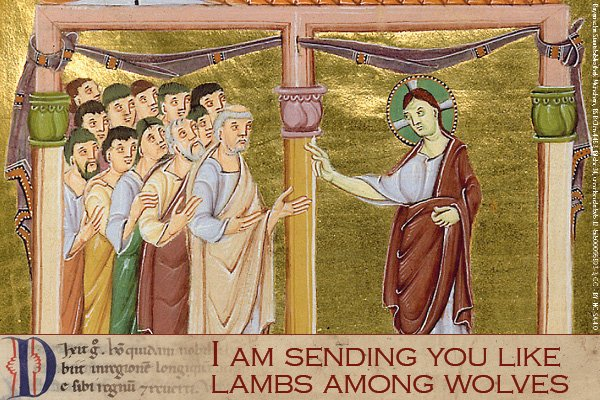
gather this  weekend  the schools have closed for the summer break and the holidays have begun. We remember those who are going through tough times as the cost of living continues to rise and we pray for the peace of the world especially for peace in Ukraine. This Sunday’s Gospel reading tells us about Jesus appointing the 72 others and then sending them out in pairs to the towns he was going to visit. As he gives his missionary instruction Jesus seems under no illusion about the territory compared to the wolves roaming around, his own crowds are like lambs. He tells the 72 to lead the radical lifestyle of the wandering preacher who must face homelessness and renunciation of family and property. When they enter a house they should bless it with peace. The Gospel also tells us about the practical things to direct the people  as they proclaim the Good News of the Kingdom and in rebuilding community life. Jesus told them to carry no purse, no haversack, and no sandals. Proclaiming the Good News of the Kingdom and community life are two sides of the same coin. One does not exist and cannot make sense without the other.

 There is a clear urgency about the task in hand Jesus says, “Start off now” with urgency in his voice. On their return the disciples were delighted that their mission has actually worked! Their joy demonstrates that people do welcome the word of God and that the word of God is their real resource for mission. Jesus counsels them to rejoice not because their mission has worked but because their names are written in heaven. There is a line in this gospel reading that struck me when  Jesus tells us that the Harvest is rich and the labourers are few. This is so very true today when we have a shortage of men  coming forward to enter the vocation of service that is the priesthood and religious life. But that said we need to keep on Praying for vocations and encouraging people young and not so young to become priests and religious.  There will be a time of crisis and for some we are living in a time of crisis with so many things that are wrong in our world. There will be times, as we know, when the scorpions will bite us, and when the wolves will have their day.  Jesus speaks to us today in order to reassure us and he tells us to hold on to all that is good. May our hearts our minds be open to his words! May our hearts direct our minds! And may our minds direct our hands in the work of the Lord.  

It is our responsibility as people of faith to exercise our mission as the people of God the Body of Christ. The fullness of life is the message and the mission of Jesus  who empowers us in our time and place  to do his work, and to work in his name.  Jesus assures us that we have a passport, visa, and “green card” for heaven. Our names are already registered there and our mission is to proclaim the good news of salvation to others by our words and our deeds so that the world will believe.

33rd SUNDAY IN ORDINARY TIME

download (1)

We pray today for all those who perished in Paris on Friday night this atrocity serves no one. This Sunday in our Gospel story we hear about the End times and I am sure that the people who died didn’t  think that they were approaching their end times may all of them through the mercy of God rest in peace.

For the past two millennia, Christians have looked to the future and asked, “When, Lord, when is all this going to kick off?” Jesus saw the end of time event as the visit of the divine King. God would prepare the visit with cosmic signs and events as a means of announcement. The King would arrive in a way that reflected his power and reputation (on the clouds); his messengers (“angels”) would go throughout the known world to gather all the faithful. Remember that the Jewish people had been displaced throughout the known world because of economic opportunity or oppression. Jesus implied that the injustice of Jews living on foreign soil would be corrected during his lifetime  How did his disciples know Jesus spoke the truth? Jesus gave a farming analogy of the fig tree to support his belief in God’s immanent judgement.

Every spring we observe the twigs on a bare tree start to grow and go green then Leaves appear and we know that summer is on the horizon. As Spring is a prelude to Summer, and Autumn warns of Winter so we must not be complacent, imagining that life can be held in suspension because life keeps marching on.

After the cosmic fireworks, Jesus imagines a peace beyond suffering. This vision of peace is important for Mark’s persecuted community: they need more than a firework display to see them through their own historical apocalypse. If their hope is not to be exhausted by force of circumstances, they need help to imagine a far side to pain and suffering. Mark gives their hope help in sharing Jesus’ vision. For that is the purpose of all apocalyptic writing: to fund the hope of those who suffer in the present. We live in an age of uncertainty: the future never looks wholly secure. But Jesus holds out a vision that takes us beyond our worst imaginings. There is a place beyond the mountains of arms and weapons, beyond environmental damage and terrorism. This vision doesn’t free us from the duty to strive for peace and right living, but it does free us from the blasphemy of believing that a nuclear holocaust will be the last word in the human story. In the meantime, we have to depend on the promise of Jesus: “Heaven and earth will pass away, but my words will not pass away.” No one, not even the Son, knows when all this will take place. The only sure thing we can hold on to is the word of Jesus and all we are asked to do is hold fast to what we know to be good and in these times when we look at all that is happening around us this is good advice.

32nd SUNDAY IN ORDINARY TIME

Widows-Mites-Display

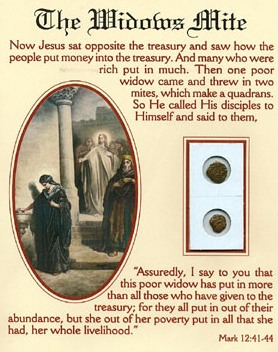
This Sunday in our Gospel story we hear about the widows mite. Mark sharpens the lesson Jesus gives, by linking this incident with what he has to say about ‘scribes’ who ‘swallow the property of widows while making a show of lengthy prayers’. The situation of widows was insecure. The ‘scribes’, so often mentioned in the gospels, were interpreters of the Law of old Israel they were the lawyers of the day But beneath their exterior religious garb, they were rapacious and in many respects just didn’t give a damn as long as they had what they wanted. The widow, on the other hand, reveals the true religious practice of those who have little, but express great trust in God to provide for them.

Jesus makes a series of charges against the scribes. He criticises their habit of wearing distinctive dress, which marks them as different from others and is calculated to win people’s deference. He criticises their habit of taking the places of honour at religious and civil functions. He criticises their habit of long-winded prayers, made not to God but to their immediate audience. Finally, he denounces their practice of exploiting helpless widows by living off their savings.

In contrast to the counterfeit piety of the scribes, Jesus honours true piety in the generosity of the poor widow. The pious frauds who abused their religious status could take a lesson from a woman who had no status in their religion or society, a poor widow. The two small coins make up the total of her resources. She could have kept one. She doesn’t. Her generosity cannot be bettered. For Jesus, true generosity is measured not by what people give but by what they have left after they give. The poor widow leaves herself with nothing. She cannot give more, for she has nothing more to give. In Jesus’ estimation she is a mighty widow.

We, need to listen to Jesus’s words. We are tempted to preserve our systems and benefit from what they give us: standing in the community, predictability, stability and a blessing of the status quo. The church’s history also reveals how we have blessed armies that invaded and enslaved indigenous peoples, preached slavery and oppression. Our religious apparatus has tended to side more with Caesar and with the economic and political world that belongs to Caesar. Jesus condemns those individuals and institutions that benefit from the burdens put on the poor. He said previously in Mark (11:17) that the Temple had become a den of thieves and not a house of prayer.

He predicted it would all come tumbling down.  Today’s passage illustrates why this destruction was inevitable, because those in the temple were corrupt. Every day demands are made on us. We are called on to be generous with our love, our forgiveness, our patience, our resources. The good news is that when we do that out of love, Jesus will be our constant support through the good and bad and happy and sad times which we often find ourselves in.

THE FEAST OF ALL SAINTS

images (3)

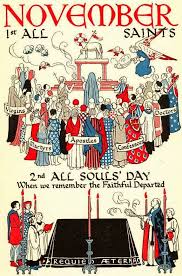
This Sunday we celebrate the Feast of All Saints, the Church’s “Hall of Fame.” They are the men and women who “hung in there” despite all sorts of obstacles, to faithfully believing in God and His Son, Jesus. They are the ones who were truly lovers and followers despite their own sinfulness and weaknesses. During the early centuries the Saints venerated by the Church were all martyrs. Later the  1st  November was set  as the day for commemorating all the Saints.  All of us have this “universal call to holiness.” What must we to do in order to join the company of the saints in heaven? We “must follow in Jesus footsteps and try to conform ourselves to his image as we seek  to do  the will of the Father in all things In this way, the holiness of the People of God will grow into an abundant harvest of good, as is admirably shown by the life of so many saints in Church history” (Lumen Gentium)

In today’s Gospel  which is the beatitudes we have Jesus’ charter for his kingdom,. When we listen to the beatitudes we can all put faces to the virtues. We remember these people and we know them. The people whose simplicity and littleness shine like a light in a world of darkness. The gentle folk whose energetic non-violence will never win medals. Those who cry and mourn their loss because they have tasted the presence of love.  The ones who hunger for what is right and who stay hungry until what is right becomes a reality. Those who scandalise us with their mercy because they exclude no one from its embrace. The people who have an undivided heart, whose loyalty to God is never in question. Those who not only look for peace but do everything in their power to make peace and build a kingdom among the ruins.This summary of Jesus’ teaching gives expression to the heart and spirit of the life to which Jesus calls us. True happiness, Jesus declares, will be found by those for whom their relationship with God means more to them than earthly goods – a “poverty of spirit, ” a “meekness” and “gentleness” after the example of Jesus, a “hunger for justice” that shapes what we do according to the values of the Kingdom, in sum “a pure (i.e. undivided) heart.” These are the ideals that have inspired the saints honoured by the Church, and those countless others known only to God.  

The Beatitudes are a sign of contradiction to the world’s understanding of happiness and joy.  How can one possibly find happiness in poverty, hunger, mourning, and persecution?  Poverty of spirit finds ample room and joy in possessing God as the greatest treasure possible.  Hunger of the spirit seeks nourishment and strength in God’s word and Spirit.  Sorrow and mourning over wasted life and sin leads to joyful freedom from the burden of guilt and spiritual oppression.  God reveals to the humble of heart the true source of abundant life and happiness.  Jesus promises his disciples that the joys of heaven will more than compensate for the troubles and hardships they can expect in this world.  Thomas Aquinas said: No one can live without joy.  That is why a person deprived of spiritual joy goes after carnal pleasures.  Do you know the happiness of hungering and thirsting for God alone? So the question to ask ourselves today is are we prepared to take up the attitudes of the Beatitudes and make them our way of life?

30TH SUNDAY IN ORDINARY TIME

b55

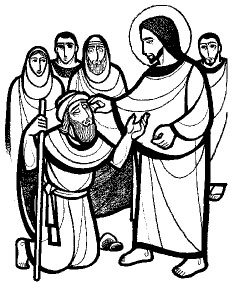
In our Gospel for this Sunday Christ walks along the streets of the ancient city of Jericho even in Jesus time the city of Jericho was already thousands of years old. With his disciples and a great crowd following him, our Lord is leaving the city and Bartimaeus the blind beggar calls out to him in dire need: “Jesus, Son of David, have pity on me.” Bartimaeus, though blind, could see. His instincts were sharper than a fresh razor blade. The divinity of Jesus had come across to him in waves. But those  around and about him, who enjoyed good vision, were blind to the Son of Man. The blind and deaf Helen Keller said, “The most beautiful things in the world can’t be seen or even touched. They must be felt with the heart.” It is possible for good people to spend their days searching but never finding their spiritual hearts.

I often feel that I am going around in circles looking for this or that way of curing my own spiritual blindness. But I always come to the same conclusion that faith in God is what it is all about. Spiritual blindness often prevents people from perceiving the correct way a follower of Jesus should live. Our following of Jesus is not compulsory.

We cannot be compelled to love or to accept the mission of God to transform the world after the pattern that Jesus gave us that is our own free choice. We must not accept the voices that would have us silenced and there are so many in our modern world and many of those voices are blind to the Spiritual heart of faith. The gift we seek is sight, that is the ability to capture the vision of a new creation brought about by a faith filled community of people. Of course we will be afraid. Our reflection on the lives of those who have gone before us tell us that the way of discipleship can lead us into paths we may find difficult  The Gospel stories we have heard over these past weeks reveal how blind the disciples and the people around them really were. The bewildered confusion of the twelve; the cruel reaction of the crowd, who “scolded Bartimaeus and told him to keep quiet’”; the blindness of those in Jerusalem determined to destroy him. Through this miracle, Jesus makes Bartimaeus a living sign of what he is doing in the name of his Father – healing the world’s blindness, leading the human family to see in him the truth of God’s ways and not the way of the world. Discipleship is not about having possessions. Bartimaeus had no possessions except his cloak. But he even casts that aside to get up and come to Jesus.

He is a powerful symbol for us: what little he has he puts aside to get closer to Jesus. The last line of the story captures the gospel message. Jesus immediately gives the man his sight to his eyes and his heart. With the gift Jesus has given him he can see where he is to go he gets up and follows Jesus. The gift was swift in coming and Bartimaeus responds just as quickly. “Immediately he received his sight and followed him on the way.” “The way” is symbolic language for those who follow Jesus. The disciples, on the road with Jesus, must have thought of themselves as part of the “in crowd,” the way James and John did when they asked Jesus to give them seats of power in his kingdom  in last Sundays Gospel (Mark 10:35-45). While they were physically close to Jesus, they were a long way from understanding and taking his message on board. The blind beggar, with nothing but a cloak, was exactly the kind of person Jesus noticed and invited to come close while those with Jesus still didn’t get it  and as a result they were not his true followers on “the way.” God wants us to say truthfully in the silence of our hearts, “Lord that I may see.” Jesus wants our prayer like that of Bartimaeus to come from a sincere heart that asks not only for the gift of sight so that we can see the world around us, but also for the gift of seeing – of seeing the truth, or the lack of it in the depths of our being, and then taking the action necessary to reverse our blindness.

Bartimaeus the clever man that he was saw Christ with the eyes of faith and  a faith filled heart. So you and I must also look and see Jesus with the eyes of faith so that we may be able to see more clearly what we have to do as people of faith to lead others to Christ.

Post Navigation