Fullerton T

RELIGION LITURGY AND LIFE

32nd SUNDAY IN ORDINARY TIME
Widows-Mites-Display

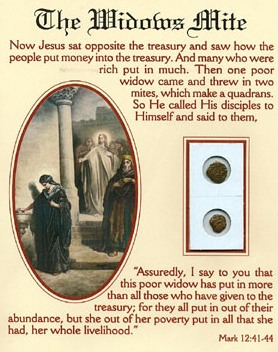
This Sunday in our Gospel story we hear about the widows mite. Mark sharpens the lesson Jesus gives, by linking this incident with what he has to say about ‘scribes’ who ‘swallow the property of widows while making a show of lengthy prayers’. The situation of widows was insecure. The ‘scribes’, so often mentioned in the gospels, were interpreters of the Law of old Israel they were the lawyers of the day But beneath their exterior religious garb, they were rapacious and in many respects just didn’t give a damn as long as they had what they wanted. The widow, on the other hand, reveals the true religious practice of those who have little, but express great trust in God to provide for them.

Jesus makes a series of charges against the scribes. He criticises their habit of wearing distinctive dress, which marks them as different from others and is calculated to win people’s deference. He criticises their habit of taking the places of honour at religious and civil functions. He criticises their habit of long-winded prayers, made not to God but to their immediate audience. Finally, he denounces their practice of exploiting helpless widows by living off their savings.

In contrast to the counterfeit piety of the scribes, Jesus honours true piety in the generosity of the poor widow. The pious frauds who abused their religious status could take a lesson from a woman who had no status in their religion or society, a poor widow. The two small coins make up the total of her resources. She could have kept one. She doesn’t. Her generosity cannot be bettered. For Jesus, true generosity is measured not by what people give but by what they have left after they give. The poor widow leaves herself with nothing. She cannot give more, for she has nothing more to give. In Jesus’ estimation she is a mighty widow.

We, need to listen to Jesus’s words. We are tempted to preserve our systems and benefit from what they give us: standing in the community, predictability, stability and a blessing of the status quo. The church’s history also reveals how we have blessed armies that invaded and enslaved indigenous peoples, preached slavery and oppression. Our religious apparatus has tended to side more with Caesar and with the economic and political world that belongs to Caesar. Jesus condemns those individuals and institutions that benefit from the burdens put on the poor. He said previously in Mark (11:17) that the Temple had become a den of thieves and not a house of prayer.

He predicted it would all come tumbling down.  Today’s passage illustrates why this destruction was inevitable, because those in the temple were corrupt. Every day demands are made on us. We are called on to be generous with our love, our forgiveness, our patience, our resources. The good news is that when we do that out of love, Jesus will be our constant support through the good and bad and happy and sad times which we often find ourselves in.
THE FEAST OF ALL SAINTS

images (3)

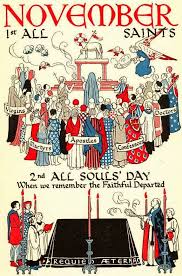
This Sunday we celebrate the Feast of All Saints, the Church’s “Hall of Fame.” They are the men and women who “hung in there” despite all sorts of obstacles, to faithfully believing in God and His Son, Jesus. They are the ones who were truly lovers and followers despite their own sinfulness and weaknesses. During the early centuries the Saints venerated by the Church were all martyrs. Later the  1st  November was set  as the day for commemorating all the Saints.  All of us have this “universal call to holiness.” What must we to do in order to join the company of the saints in heaven? We “must follow in Jesus footsteps and try to conform ourselves to his image as we seek  to do  the will of the Father in all things In this way, the holiness of the People of God will grow into an abundant harvest of good, as is admirably shown by the life of so many saints in Church history” (Lumen Gentium)

In today’s Gospel  which is the beatitudes we have Jesus’ charter for his kingdom,. When we listen to the beatitudes we can all put faces to the virtues. We remember these people and we know them. The people whose simplicity and littleness shine like a light in a world of darkness. The gentle folk whose energetic non-violence will never win medals. Those who cry and mourn their loss because they have tasted the presence of love.  The ones who hunger for what is right and who stay hungry until what is right becomes a reality. Those who scandalise us with their mercy because they exclude no one from its embrace. The people who have an undivided heart, whose loyalty to God is never in question. Those who not only look for peace but do everything in their power to make peace and build a kingdom among the ruins.This summary of Jesus’ teaching gives expression to the heart and spirit of the life to which Jesus calls us. True happiness, Jesus declares, will be found by those for whom their relationship with God means more to them than earthly goods – a “poverty of spirit, ” a “meekness” and “gentleness” after the example of Jesus, a “hunger for justice” that shapes what we do according to the values of the Kingdom, in sum “a pure (i.e. undivided) heart.” These are the ideals that have inspired the saints honoured by the Church, and those countless others known only to God.  

The Beatitudes are a sign of contradiction to the world’s understanding of happiness and joy.  How can one possibly find happiness in poverty, hunger, mourning, and persecution?  Poverty of spirit finds ample room and joy in possessing God as the greatest treasure possible.  Hunger of the spirit seeks nourishment and strength in God’s word and Spirit.  Sorrow and mourning over wasted life and sin leads to joyful freedom from the burden of guilt and spiritual oppression.  God reveals to the humble of heart the true source of abundant life and happiness.  Jesus promises his disciples that the joys of heaven will more than compensate for the troubles and hardships they can expect in this world.  Thomas Aquinas said: No one can live without joy.  That is why a person deprived of spiritual joy goes after carnal pleasures.  Do you know the happiness of hungering and thirsting for God alone? So the question to ask ourselves today is are we prepared to take up the attitudes of the Beatitudes and make them our way of life?

30TH SUNDAY IN ORDINARY TIME

b55

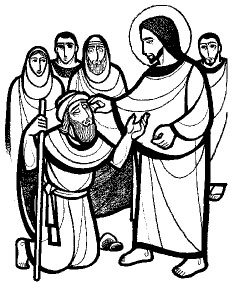
In our Gospel for this Sunday Christ walks along the streets of the ancient city of Jericho even in Jesus time the city of Jericho was already thousands of years old. With his disciples and a great crowd following him, our Lord is leaving the city and Bartimaeus the blind beggar calls out to him in dire need: “Jesus, Son of David, have pity on me.” Bartimaeus, though blind, could see. His instincts were sharper than a fresh razor blade. The divinity of Jesus had come across to him in waves. But those  around and about him, who enjoyed good vision, were blind to the Son of Man. The blind and deaf Helen Keller said, “The most beautiful things in the world can’t be seen or even touched. They must be felt with the heart.” It is possible for good people to spend their days searching but never finding their spiritual hearts.

I often feel that I am going around in circles looking for this or that way of curing my own spiritual blindness. But I always come to the same conclusion that faith in God is what it is all about. Spiritual blindness often prevents people from perceiving the correct way a follower of Jesus should live. Our following of Jesus is not compulsory.

We cannot be compelled to love or to accept the mission of God to transform the world after the pattern that Jesus gave us that is our own free choice. We must not accept the voices that would have us silenced and there are so many in our modern world and many of those voices are blind to the Spiritual heart of faith. The gift we seek is sight, that is the ability to capture the vision of a new creation brought about by a faith filled community of people. Of course we will be afraid. Our reflection on the lives of those who have gone before us tell us that the way of discipleship can lead us into paths we may find difficult  The Gospel stories we have heard over these past weeks reveal how blind the disciples and the people around them really were. The bewildered confusion of the twelve; the cruel reaction of the crowd, who “scolded Bartimaeus and told him to keep quiet’”; the blindness of those in Jerusalem determined to destroy him. Through this miracle, Jesus makes Bartimaeus a living sign of what he is doing in the name of his Father – healing the world’s blindness, leading the human family to see in him the truth of God’s ways and not the way of the world. Discipleship is not about having possessions. Bartimaeus had no possessions except his cloak. But he even casts that aside to get up and come to Jesus.

He is a powerful symbol for us: what little he has he puts aside to get closer to Jesus. The last line of the story captures the gospel message. Jesus immediately gives the man his sight to his eyes and his heart. With the gift Jesus has given him he can see where he is to go he gets up and follows Jesus. The gift was swift in coming and Bartimaeus responds just as quickly. “Immediately he received his sight and followed him on the way.” “The way” is symbolic language for those who follow Jesus. The disciples, on the road with Jesus, must have thought of themselves as part of the “in crowd,” the way James and John did when they asked Jesus to give them seats of power in his kingdom  in last Sundays Gospel (Mark 10:35-45). While they were physically close to Jesus, they were a long way from understanding and taking his message on board. The blind beggar, with nothing but a cloak, was exactly the kind of person Jesus noticed and invited to come close while those with Jesus still didn’t get it  and as a result they were not his true followers on “the way.” God wants us to say truthfully in the silence of our hearts, “Lord that I may see.” Jesus wants our prayer like that of Bartimaeus to come from a sincere heart that asks not only for the gift of sight so that we can see the world around us, but also for the gift of seeing – of seeing the truth, or the lack of it in the depths of our being, and then taking the action necessary to reverse our blindness.

Bartimaeus the clever man that he was saw Christ with the eyes of faith and  a faith filled heart. So you and I must also look and see Jesus with the eyes of faith so that we may be able to see more clearly what we have to do as people of faith to lead others to Christ.

MISSION SUNDAY 29TH SUNDAY IN ORDINARY TIME

MISSION SUNDAY

This Sunday we celebrate the international missionary effort of the Church throughout the world. Today we celebrate World  Mission Sunday. Here in Ireland for many centuries there have so many Irishmen and women  who have gone to foreign lands to bring the faith of our fathers to those who might not have got the faith otherwise. There have also been many people like Saint Patrick who in their turn have brought the faith to Ireland as missionaries. This Sunday celebrates the great missionary spirit that has brought the faith to all corners of the world over so many years.

In today’s Gospel two brothers James and John the sons of Zebedee are asking Jesus for a big favour to ensure their privileged seating arrangements when they come to meet Jesus in glory. The favour they want from Jesus is simply favouritism. They want to sit, one at Jesus’ right hand and the other at his left. While they don’t specify which of them should sit at Jesus’ right  no doubt that problem would have emerged later  they imagine themselves in a cosy triumvirate of their own devising. Of course Jesus blows this notion out of the water when he tells the two brothers that they don’t know what they are asking. Their request is to share Jesus’ power when he comes into glory, so timing their appointment to begin when the suffering is done but this is not the way of things.

Jesus  has already spoken about how he will be handed over to the religious authorities, who will condemn him to death and hand him over to those who will mock him and scourge him and put him to death remember Good Friday. The two disciples mention nothing of all this but Jesus reminds them.  Jesus brings the conversation back to what happens before the glory which is all about suffering not about the glory the glory comes as a result of the suffering. Jesus’ kingdom is not about who wears the crown, but who bears the cross. So he asks the brothers as he asks us today: “Can you drink the cup that I must drink, or be baptised with the baptism with which I must be baptised?” They boast that they can. Jesus tells them that they will have a share in his sufferings, but it isn’t for him to assign who sits where in the kingdom. The message is clear: there is no shortcut to God’s favour.

]Jesus does what he asks others and that includes you and me to do: that is to serve, not to be served; to give love freely, not to exact everyone’s worship; to reach out to those in need, not to wait for adoring approval. Christian discipleship and missionary endeavour which we celebrate today are a service industry and there is much work out there for everyone to do. This type of service should continue in the Church when that happens we will be a serving missionary people. To be servants in the way that Jesus was servant means to live in complete trust that God loves us in the way that God loved Jesus during his earthly life.

 Jesus was not  a servant out of fear of a tyrant Father, but as beloved Son, who in turn loved as he was loved. It is a free service of love, not of fear. When the Apostle Paul was cured of his blindness, he was able to say in a letter to the Christians of Ephesus: “… be imitators of God … and live in love, as Christ loved us and handed himself over as a sacrificial offering to God …” (Ephesians 5: 1–2)

]Mission Sunday  gives us the opportunity to thank god for the faith that we have as well as thanking god for and acknowledging all those faithful missionary men and women who left everything in order to bring the faith to the far corners of the world. We pray that the Lord of the harvest will continue to inspire many people to join the missionary orders and we also pray for vocations in general to the priesthood and religious life.

28TH SUNDAY IN ORDINARY TIME

download (3)

Here we are at the 28th Sunday in ordinary time with September a distant memory and now we are well into October the month of the Rosary. At this stage we should be settled into the routines of school and work, routines that are often abandoned during the summer months for a more relaxed way of life.

In our second reading this Sunday we hear about the word of God being alive and active God’s Word can be likened to a two-edged sword. It is living and effective. Even now the word of God gets to the heart of things and it divides the real from the unreal so that we are forced to face up to the uncomfortable truths it may be pointing out to us whatever they may be. In this Sundays Gospel Mark paints a vivid scene of a rich man meeting Jesus on the road to Jerusalem. The rich man is eager, impetuous and effusive. The prophet from Nazareth is calm and practical as he meets the seeker’s enthusiasm with the challenge of the kingdom. When the rich man throws himself at the feet of Jesus and addresses him as “Good master”, Jesus tells him that God alone is the good. When the man asks Jesus what he must do to inherit eternal life, Jesus gives him the standard rabbinical answer – keep the commandments.

Jesus looks on the rich man with love; he wants this blameless enthusiast to become one of his disciples. So the challenge is made: “There is one thing you lack. Go and sell everything you own and give the money to the poor, and you will have treasure in heaven; then come, follow me.” The cost of Christian discipleship is heavy for this prospective disciple: he must renounce his security and the prestige his wealth brings him; when he sells everything he owns, he must not give the money to his family or friends, but to the poor. If he does this he will have treasure in heaven. That treasure will be his new security.

Then Jesus tells the apostles to detach themselves from possessions. The rich man is a good person, but he cannot let go of the physical goods he has in order to receive the riches of following Jesus and his sought-after eternal life. Ordinary religious practice and observances are not enough. Jesus asks the extraordinary from his followers, not only giving up possessions, but their very lives, to follow him .Over the years since these words were first spoken right down to us in our own times  many many people have got up and followed Jesus and by doing this they have inspired countless others to take up the road less travelled. This will be the same as we go into the future as many more will come to accept the challenge of Jesus to follow him. We remember that the true Christian, whose principal purpose in life is to serve God, will not overburden him or herself with unnecessary pieces of luggage; instead the true Christian will travel light and be ever ready to help others also to carry their burdens.

27TH SUNDAY IN ORDINARY TIME

download (2)

This Sunday in the Gospel we tackle the thorny  issue of marriage and divorce; Jesus is asked an awkward question about the legality of divorce. He lays down very clearly what God intends for marriage is what is found in Genesis (where the “two become one” for all time) rather than the dispensation granted through Moses (permitting a writ of divorce) which was an exception, not the rule How then did the Christian community come to recognize that easy divorce was not in accordance with the original plan of God? Mark tells us that Jesus cited Genesis to provide the basis of a new understanding of human community. This is an important point as it is an example of one of the many times Jesus showed both his disciples and his critics that it was dangerous to build a case based on one passage from Scripture. By referring to Genesis he pointed them gently in a new direction. If marriage is the formation of “one body”, then the body created by God, cannot be destroyed by humans. As Jesus preached the coming of the kingdom as a new way of being before God therefore disciples would strive to carry out the dream of God in its fullest expression.

Christianity is a religion of reason and conforms in all its aspects to the rational nature of man its basis is the revelation of God who became man and is the author and foundation of all things yet it is the heart of mankind rather than his intellect which Christ means to capture.

The assent of the intellect to the doctrine revealed by Christ is not sufficient in itself for a Christian to earn the eternal kingdom; faith is the acceptance and commitment of the believer to God through Jesus Christ. The person who has faith commits himself or herself to God with childlike trust, assured that if he does all that he can God will do the rest. This is the kind of faith that will move mountains that loom so large in the vision of too many Christian’s mountains that challenge the Christian and his or her way of living life we all know what they are. If we are to be his followers Christ asks us to take up our cross each day and follow him and that means we take the way of the cross after him. Our daily cross is made of the troubles and trials of life from which no one can escape. They can be borne with reluctance and grumbling or they can be accepted as the loving God’s means of training us for the future life.  We don’t know in advance what God may do with us and our own oftentimes selfish plans.

To those who have faith, all things are possible the old saying that faith moves mountains is certainly true. We don’t  know when personal illness, bereavement or some other trying experience will put us to the test. But we do know that our life will be a success if we set our hearts and minds on values that go beyond all the transitory goods of this world. Our faith, is leading us onwards and forwards, it is always pointing to something still to come, and at the end of our pilgrimage on this earth we will find where our true treasure is but in the meantime we have to keep on going though it is sometimes hard. Remember the saying that faith moves mountains but keep on climbing!!!

l

images (5)

Few of us go through life without joining some kind of group or club. Joining a particular group, religious, political or social, can enlarge our world and introduce us to new people and new possibilities. It can help us to move within a relatively secure network of relationships. That sense of belonging is important to our identity: membership is proof of how others accept and recognise how we see ourselves. Rejection is a clear signal of disapproval and this is what the Gospel reading is all about this Sunday; Rejection of those who are not of our religious belief or whatever. The exorcist in the Gospel is put before us this weekend as the example of someone who was rejected and the gospel then goes on to tell us about the acceptance that Jesus has for those people such who were rejected. Don’t forget that Jesus suffered the ultimate rejection on the Cross of Good Friday.

The disciples consider Jesus their own personal treasure and they want him for themselves. They seemed to have been an ambitious group last Sunday we heard them arguing over who was the greatest among them. This Sunday they complain that they saw someone who was not part of their group performing a healing in Jesus’ name.

If there had been laws  concerning  copyright way back then I think the Apostles would have copyrighted Jesus name and the power that went along with it. I can just imagine them licensing the use of Jesus’s name and then asking “How many times do you want to use Jesus’s name that will cost so much. How many times do you want to cure someone in his name that will be so much more”. They felt they were privy to Jesus that is to say he was the apostles and no one else’s.. It’s as if Jesus is a rock star and they are his agents, with exclusive rights over what he does and says. What they really wanted was a tidy little religious box, clearly in their control but they hadn’t factored in Jesus and what he had been sent into the world to do. They forgot the size of his heart, remember it had no limits. They forgot how big his compassion was, remember it never ran out and wasn’t limited to the few who under the law had the proper credentials or disposition to receive it.

There was plenty for everyone in terms of faith then as there is now. Jesus is the visible face of the God that we can’t see and yet we believe; we believe in the God who wants to speak words of love and joy to all, not just a few; who wants to reach out and touch all those broken of limb, and broken of spirit, not just those who belong to our club or carry the right credentials.

After they see Jesus crushed on the cross and later, when he rises from the dead, the apostles finally get the message and understand what had happened to them as a result of their involvement with Jesus. Then they would do exactly what we’re doing right now, retell the stories about Jesus as they set out to continue the story without restrictions or limits of any kind; When they did all of this they would have been speaking and acting in Jesus’ name, not just for a select few, but for everyone they met, or came to them in any need. In Jesus’ name they opened the eyes of the blind, cured the cripples, and even raised the dead. At first they got it wrong, but then they learned what it meant to speak and act in Jesus’ name everything was possible for them.

In our world today we often forget that our faith is not about the select few but our faith is for everyone. We need to remember that we don’t always get it right and remember that everything is possible to those who have faith in the name and person of Jesus Christ the Son of God.

25TH SUNDAY OF ORDINARY TIME

images (1)

In our Gospel for this Sunday we begin with the second prediction of the passion. Like many things in the biblical tradition, a threefold repetition gives emphasis and dignity to the pronouncement. The predictions are also a reminder to us that Jesus was not surprised by the later events in Jerusalem; he had seen them on the horizon for a great part of his journey. The predictions are each constructed in the same way with Jesus’ teaching followed by misunderstanding. Towards the end of this Gospel Jesus brings the child to centre stage and instructs his disciples: “Anyone who welcomes one of these little children in my name welcomes me; and anyone who welcomes me welcomes the one who sent me.” In this instance Jesus doesn’t ask his disciples to become like children; he asks his disciples to welcome them. The disciples have a problem about welcoming littleness because they think that they are at the top of the tree and are above this. This basic Christian teaching, common to all the Gospels, is one that has not always been honoured. “To be first in the group is to occupy the last place and to be a servant to the group.”

That means to be the greatest you must make yourself the least in service of other people especially those around you. Jesus taught his followers the true meaning of leadership. Leadership does not mean power but service. Power often strangles life and brings a slow death. But, service brings life, even from death itself. An attitude of serving others should not be a triumphal attitude lording it over everyone else, yet much of our history has been about individuals seeing themselves as better than everyone else. In this passage we listen to the words of Jesus about the child he tells us “Whoever receives a child like this in my name receives me. Whoever receives me receives God”. In the first part, the disciples are told that a measure of their discipleship is their attitude to power. In the second part, discipleship can be judged on the disciple’s attitude to children who are powerless in many ways. We only have to think about the 3 year old refugee migrant boy Aylan Kurdi who was washed up on the shore of a Turkish beach recently to know that this is so true. This horrible event along with all the migrants that have died in recent times remind all of us that Life is precious. Jesus compares himself to the little child, the one who cannot resort to power tactics when threatened or maltreated. Jesus’ protection is his Father; his trust is placed in the God who will ensure his protection. When suffering comes, Jesus refuses to abandon trust in the Father.  That trust makes him vulnerable, like a little child, but unless the disciples can come to welcome that vulnerability they will never understand the way of Jesus.

When we welcome the stranger we might understand what Jesus means in this Gospel reading that wee bit better. Jesus offers us a permanent challenge to welcome the powerless, to take to heart the weakest members of the community. He places himself in their company. Their vulnerability is something that Jesus not only shares but values. May we understand that to be be first in the group is to occupy the last place and to be a servant to the group.”  May we take up the challenge that Jesus places before us in this gospel reading and that challenge is to become humble servants of those who need us whoever they are.

24TH SUNDAY OF ORDINARY TIME

images (1)

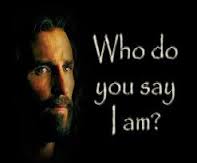
This week end in our gospel reading we hear Jesus asking Peter and the disciples the famous question “Who do you say I am?”  Jesus asks what outsiders and his disciples think about him. The guesses all lead us  to someone else, Elijah or John the Baptist or one of the prophets, figures who were celebrated for pointing forward to the Messiah. In contrast to what others think, Peter speaks on behalf of the disciples who have shared Jesus’ life intimately: he identifies Jesus as the Christ. Jesus is not numbered among those pointing to the Messiah; he is the Messiah. When Peter confesses that Jesus is the Christ, Jesus tells his disciples that his way to glory is only via suffering and the cross.  The first reading is one of the great poems of Isaiah on the theme of suffering. The servant of God is described in clear unambiguous terms. God gifts the disciple with a well-trained tongue. This is not an orator’s tongue, capable of delivering prize-winning speeches, but a tongue with the ability to rouse the weary from despair, the ability to bring comfort and compassion to the suffering. We know this response to the pain of the other does not require words but is an attitude of the heart.

Jesus in the Gospel speaks to us about himself using the figure of the Son of Man, the suffering servant who will be rejected and put to death. Not only must he suffer, but experience comfortless suffering in being rejected. That rejection robs the suffering one of his dignity. He has to face forsakenness and the loneliness of the cross. He will not die of natural causes, but be put to death. And this experience of dereliction will be answered by God who will raise him up on the third day.  Although the message given to the Disciples was only vaguely and dubiously grasped, Christ had forewarned his Apostles, in order to prepare them for the scandal and folly of the cross. While it did not really prepare them because they were still too worldly-minded, it did help to strengthen their faith once the facts of the empty tomb convinced them of the resurrection. When they realized that their beloved Master was more than Messiah, that he was in fact the Son of God, who freely accepted his humiliations and shameful death for their sakes and ours. The apostles gladly gave their lives to bringing the Good news of God’s great love for men to all the nations. From being a scandal the cross became the emblem and the proud standard of God’s love for mankind.

If Jesus was to stand beside us today and ask who do you say I am? What answer would we give would we answer the same way as Peter when he said you are Christ the son of God?

23RD SUNDAY IN ORDINARY TIME

images

This weekend our readings are all about Jesus making the deaf hear and the blind see Isaiah says in the first reading that the signs of God’s faithfulness and presence with the people, are when “the eyes of the blind are opened, and the ears of the deaf are cleared.” The physical signs of deafness and blindness are powerful symbols of being closed to the action of God. These days there are so many people who have closed their eyes and ears to the action of god in their lives. The letter of James in the second reading offers a cautionary word about making distinctions between people and many people do this especially when it comes to those of us who have any disabilities or weaknesses. It’s easy for all of us to be caught up in the standards of the world of our time and as a result we might miss the friends of God who may be those with nothing to offer us or at least that what it might seem to be. God’s preference for those who are poor according to this world is seen clearly in today’s Gospel. Jesus comes face to face with a deaf man who has a speech impediment. The man is doubly afflicted: he is a Gentile, regarded by the Jews as unclean, and is also physically disabled. Jesus takes him aside, away from the crowd, and cures his deafness and his stutter. Mark emphasises the response of the crowd, who publish their judgement that Jesus has done all things well.  Thus the messianic prophecy of Isaiah heard in the first reading is seen to be fulfilled: “the ears of the deaf [are] unsealed… and the eyes of the blind are opened”.

Jesus’s love is available to everyone, without any conditions attached. He is not disconcerted by the disabled; neither is he prejudiced against those weren’t members of his own race or religion as we see with this man. The uniqueness of Jesus was not employed to lord it over others, but to be of service to them. In his presence there is no need to hide one’s disability, no one has to remain isolated in a godless world, and no one has to be rejected. Jesus’ acceptance and love open up new possibilities; for him, nothing is settled. Prejudice, on the other hand, tries to settle everything and in reality settles nothing and causes so much hurt and anxiety.

We are people of faith, but our spiritual focus is often based on what we want. Many times we struggle between our “real needs” where god works through us. These shortcomings can lead us to discouragement many say that the “church does not fulfill my needs anymore”. On the other hand those same shortcomings can be turned around into a challenge for us to grow.

Through growth in faith, we begin to listen and understand. Then, we can speak clearly.  Our ears are no longer blocked. Our tongue is no longer held bound. Despite our shortcomings and weaknesses and all of us have many shortcomings, Jesus will touch our lives and call out to us. Are we prepared to open our ears to the call of Jesus and open our eyes to see the needs of all those around us as we are asked to do, so that people around us may say that united to Jesus in faith we have done all things well.

Post Navigation